
Fifty amps of answers.
Fifty-amp questions get straight answers here, sourced from the official Power-5 documentation. Search, or jump by category.
No matches. Try another word, or ask on Discord.
Power & inputs
Why must I wire all three power inputs?
To spread the load over more copper. Each of the three barrier inputs is rated for a maximum of 20A, so the 50A board rating only exists when all three share the load; fewer input cables lowers the whole board's ceiling. The layout also matches how popular supplies are built: a Mean Well LRS-350 or LRS-600 exposes three output terminal pairs, so three short runs of 10 AWG (5.26mm²) wire (12 AWG is the minimum) connect 1:1 from PSU to powerboard, keeping voltage drop low and delivering the high amp numbers safely.
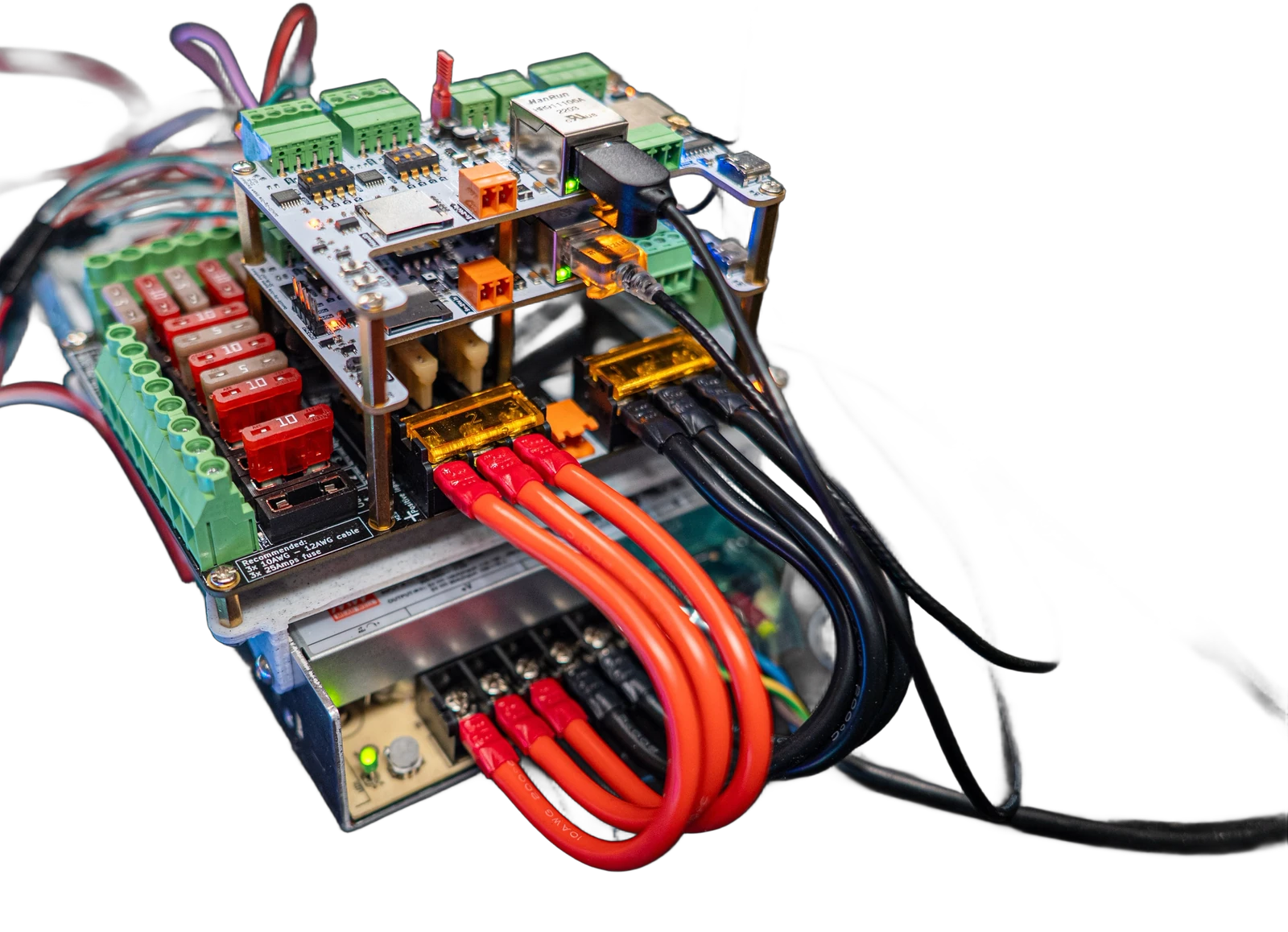
Can I connect two power supplies to one Power-5?
No, never. Connecting multiple power supplies to a single powerboard is explicitly not allowed: the PSUs end up load-sharing unpredictably, which can create a dangerous situation. The rule runs one way only; a single sufficiently large PSU may feed several powerboards at once.
What wattage can 50A actually deliver?
It depends on voltage: 50A continuous works out to 250W at 5V, 600W at 12V and 1,200W at 24V. The Power-5 accepts any supply voltage from 5 to 24V, and the fuse rules stay the same at every voltage.
How hot does the board get at 50A?
By design, roughly 25 °C above ambient at 50A continuous: in a 25 °C room the hottest point reaches about 50 °C. Help it spread that heat: plan about 4A per front feed and 8A per middle injection, and interleave heavy and light runs across the board.
Which power supply should I use?
The official picks are the Mean Well LRS-350-5 (60A at 5V) and LRS-600-12 (50A at 12V). Don't run any PSU above about 80% of its rating continuously. The full per-voltage shortlist, including fanless models, lives in the power supply recommendations on quinled.info.
Fuses
Why is the board rated 50A when the fuses total 120A?
Because fuses protect wires, they don't add up to a load rating. The 50A figure is the board's continuous thermal rating, while 12 sockets at up to 10A give headroom for transient LED peaks. Design the nominal load with the 50% RGB white values from the official power sheets; ws2815 is the exception and must be calculated at 100%.
What fuses should I use, and what comes in the box?
Match each fuse to the wire and the load on that run. The box includes 3x 25A ATO fuses for the inputs plus 6x 10A and 6x 5A for the outputs. Hard limits: 25A per input, 10A per output. Lower values are always fine and actually encouraged; larger values void the warranty. Every fuse in the box is a high quality original LittelFuse part.
Stacking
Can I still reach the fuses in a stack?
Yes, that's the Power-5's specialty. Outputs and their fuse sockets sit on two sides of the board, 8 on one and 4 on another, so they stay grabbable with more powerboards stacked above. Only the input terminals get covered: wire them before stacking, or keep the Power-5 as the top powerboard.
How does the Power-5 power my brainboard?
Two ways, both protected by a 1.5A PTC auto-reset fuse. Stacked, it feeds the brainboard through the QPowerPost standoffs with no wiring at all. Off the stack, a spare 5.08 mm feed terminal delivers the same protected output over a short cable. Either way the brainboard needs no power supply of its own.
Choosing & buying
Power-5 or Power-7: which should I pick?
Power-5 for stacks and serviceability: 12 pluggable outputs whose fuses stay reachable mid-stack. Power-7 for terminal density and thicker cable: 16 screw terminals taking 12 AWG, plus a 20A double-up trick, but its fuses need top-board placement or pre-wiring. Both are 50A, 5-24V boards with the same input stage.
Is there a 100A version of the Power-5?
No. The Power-5 is currently only available as a normal 50A version; no HC variant exists. If you need 100A of fused distribution from one board, that's the Power-7HC, which pairs the same idea with 16 screw terminals and M5 bolt inputs.
Can I get auto-reset fuses instead of blade fuses?
Only as a special order. PTC auto-reset powerboard variants exist for permanent, less-supervised installs, but they're not stocked: minimum order is 10 boards with 2 to 4 weeks of processing, arranged through the QuinLED Discord. The PTC auto-reset option page documents the available configurations.
Where can I buy the Power-5 and what does it cost?
At quinled.shop, which routes you to the trusted reseller for your region: Allnet ships worldwide (US$32.50 at the time of writing), DrZZs covers the US, Jerems covers Canada and QuinLED NL serves the EU. Fuses, connectors and stacking hardware are included in the box.