
Sixteen terminals, ten answers.
Sixteen terminals, four banks, plenty to ask. Answers below come from the official Power-7 documentation. Search, or jump by category.
No matches. Try another word, or ask on Discord.
Outputs & wiring
How do the four terminal banks work?
The board carries 4 banks of 8 screw terminals (7.62 mm): two separate positive banks and two separate negative banks, divided over three sides. One output equals one positive terminal plus one negative terminal, each output with its own fuse socket, for 16 fused feeds in total. Cable runs up to 12 AWG with a ferrule.
How does the double-up trick work exactly?
One SV5.5-5 fork crimp spans two adjacent positive terminals, a second fork spans the matching negative pair. That puts two output fuses in parallel, doubling the per-output maximum from 10A to 20A, and the fork accepts 10 AWG cable. It's made for long home runs and bus-bar style distribution.
Why does a 50A board have 16 outputs?
Because outputs are fused injection points, not sixteen full loads. Big displays want many separately fused feeds, and the 160A of total fuse headroom absorbs transient LED peaks while continuous load stays at or below the board's 50A thermal rating. Design nominal load using the 50% RGB white values; ws2815 counts at 100%.
What wattage can the Power-7 deliver?
50A continuous at your chosen voltage: 250W at 5V, 600W at 12V or 1,200W at 24V. At that full load the board is designed to run roughly 25 °C above ambient.
Fuses & stacking
What fuses should I use, and what comes in the box?
Match each fuse to the wire on that run. The box includes 3x 25A ATO fuses for the inputs plus 8x 10A and 8x 5A for the outputs. The per-output maximum is 10A (20A doubled up); lower values are always fine and encouraged, larger ones void the warranty. All included fuses are high quality original LittelFuse parts.
Can I reach the fuses in a stack?
Not under another powerboard. The screw terminals stand taller than the fuses, which makes the fuses basically impossible to get in or out with a board mounted above. Use the Power-7 as the top powerboard, or pre-wire it (xConnect pigtails are popular) before stacking. A brainboard above blocks nothing.
Choosing & buying
Power-7 or Power-5: which should I pick?
Power-7 for density and copper: 16 screw-terminal outputs, 12 AWG cable per run and the 20A double-up. Power-5 for stack serviceability: 12 pluggable outputs whose fuses stay reachable mid-stack. Both boards run 50A continuous at 5-24V with the same input stage.
What's the difference between Power-7 and Power-7HC?
The outputs are identical; the input stage isn't. The HC doubles continuous capacity from 50A to 100A using two M5 bolt terminals, MIDI fuses and extra-thick copper planes, and it costs more. It mostly makes sense for big 5V installs; at 12V and 24V the normal Power-7 covers most projects.
Why does the Power-7 have three input terminals?
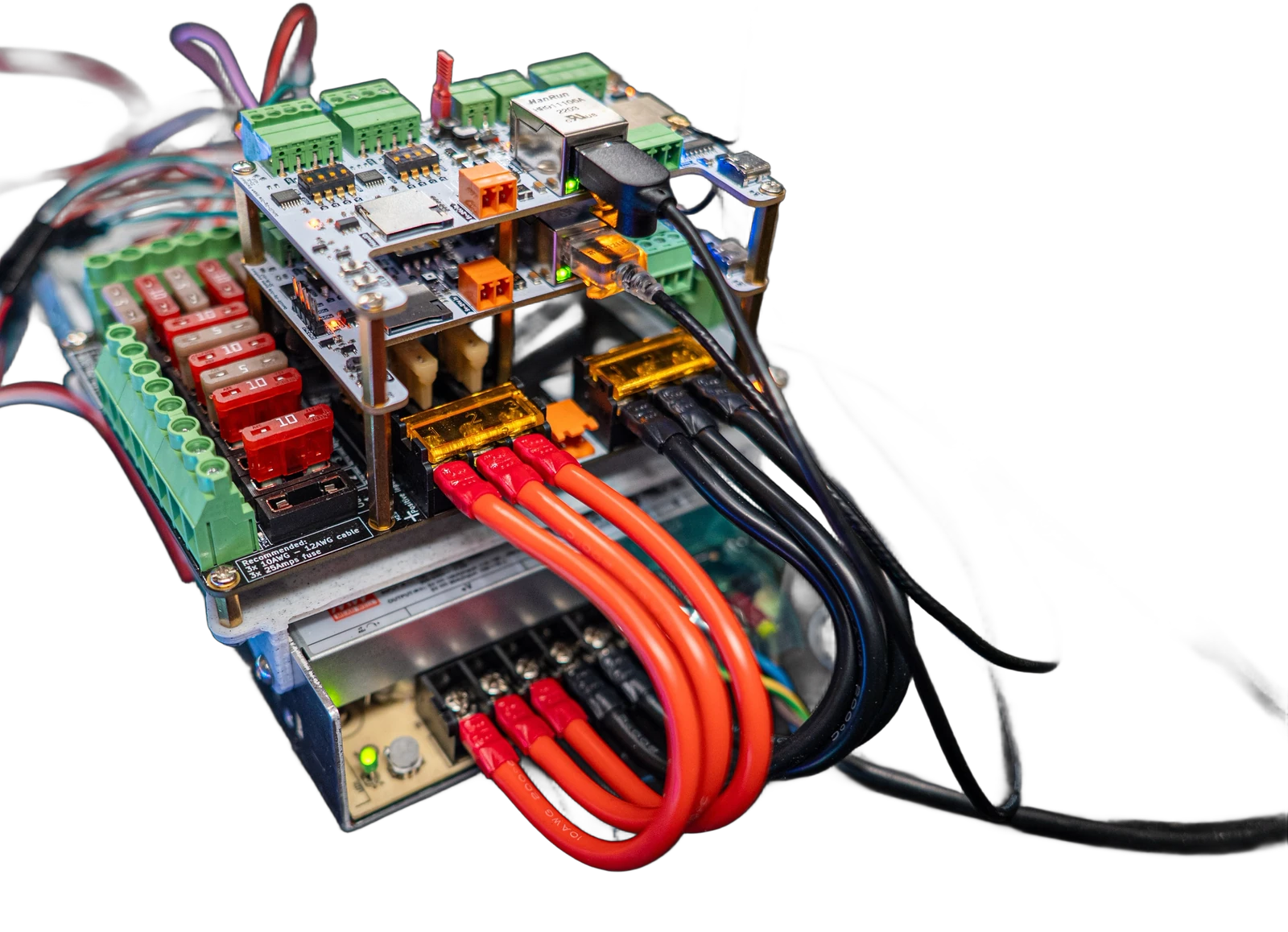
More copper, less drop. The input current splits over three barrier terminals, so three cables share what one would otherwise carry alone, with less heat per cable and less voltage lost on the way in. Popular supplies match: a Mean Well LRS-350 or LRS-600 has three output terminal pairs, so three short runs of 10 AWG (5.26mm²) wire connect 1:1 and deliver the full 50A safely.
Which power supply should I use?
The official picks are the Mean Well LRS-350-5 (60A at 5V) and LRS-600-12 (50A at 12V). Keep any PSU at or below about 80% of its rating for continuous duty. The full per-voltage shortlist, including fanless models, lives in the power supply recommendations on quinled.info.
Where can I buy the Power-7 and what does it cost?
At quinled.shop, which routes you to the trusted reseller for your region: Allnet ships worldwide (US$34.99 at the time of writing), DrZZs covers the US, Jerems covers Canada and QuinLED NL serves the EU. Fuses, the brainboard feed connector and stacking hardware are included.