
Sixteen outputs,
one board.
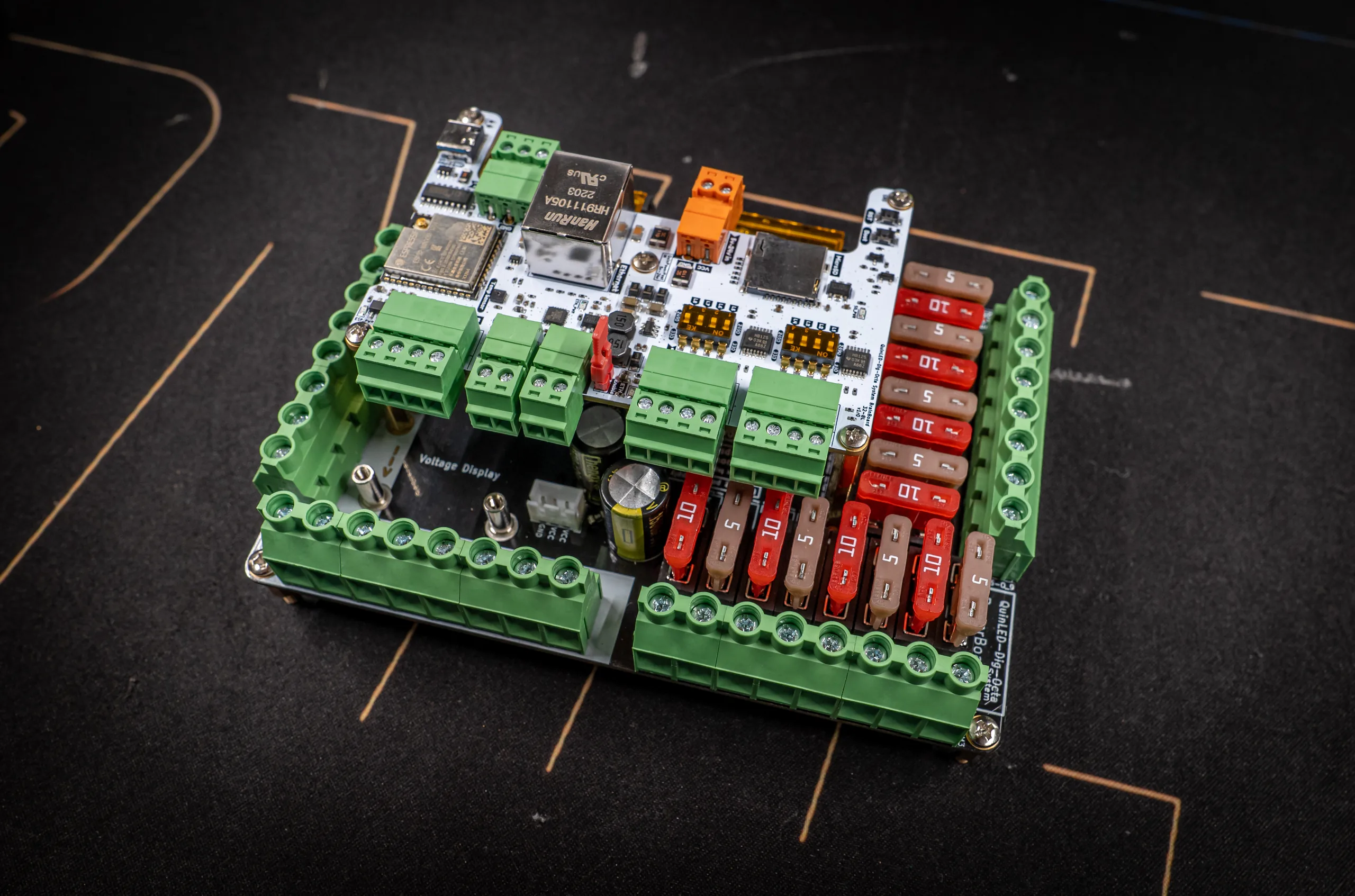
Sixteen individually fused feeds from a single board. The Power-7 carries 50A continuous at 5–24V through 7.62 mm screw terminals that take up to 12 AWG cable, and a fork-crimp trick pairs two outputs into one 20A feed for long home runs.
In production since 2022-11; the small 2024-10 v1r2 revision added extra protections around the onboard LDO. Same layout, same terminals, same ratings. Changelog in the version history.
Bus bars, retired.
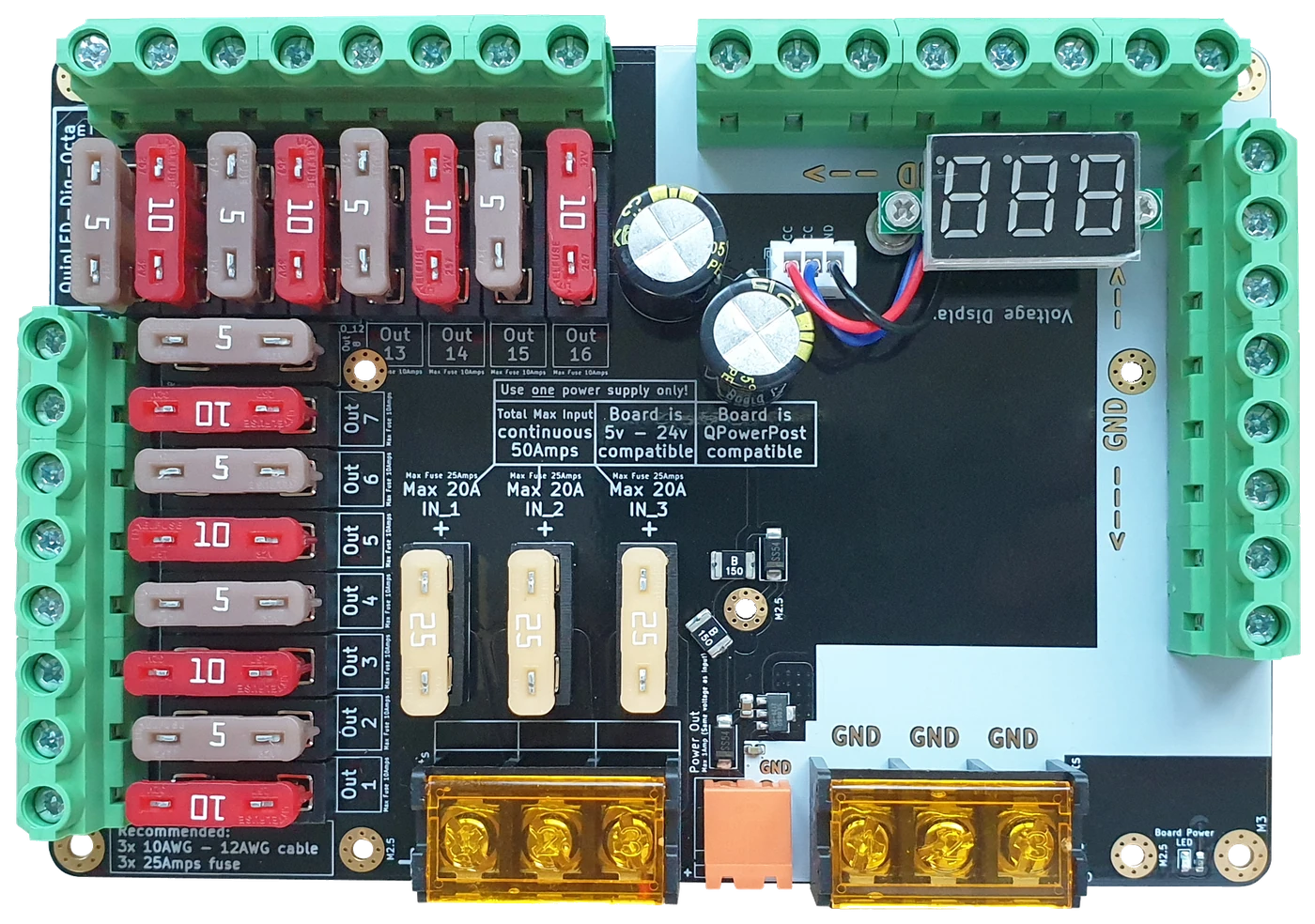
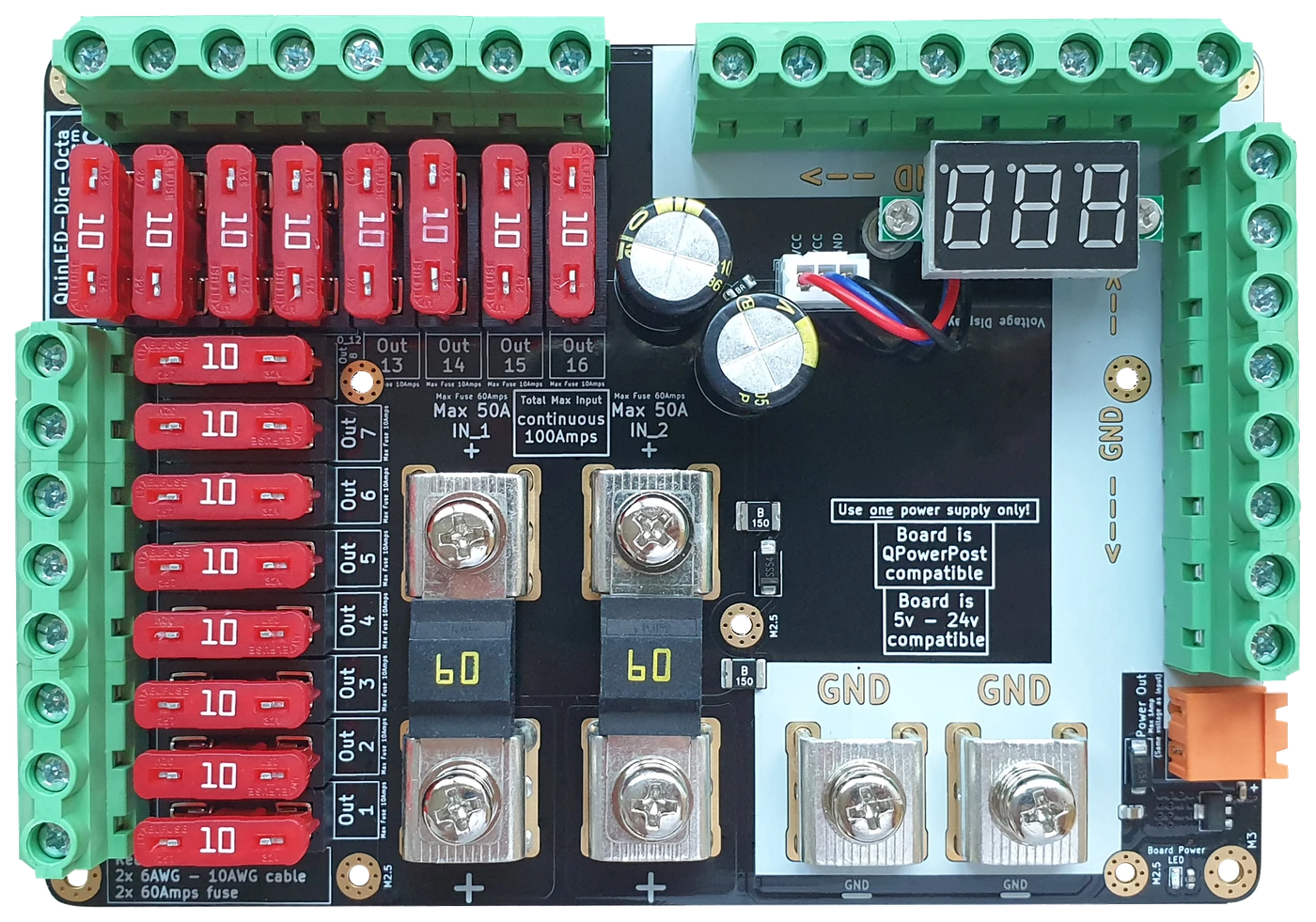
Prop-heavy displays need many separate fused feeds, and that's exactly what this board is: 16 fused outputs built as four banks of eight 7.62 mm screw terminals over three sides, two positive banks and two negative. Each takes up to 12 AWG cable with a ferrule, thicker than any pluggable port in the lineup, and there is a red blown fuse indicator per output.
Density, by design.
Every choice on the Power-7 serves terminal count: sixteen fused feeds and thick output cable from one board, with one honest trade-off on stacking.
Sixteen fused outputs
Four banks of eight 7.62 mm screw terminals over three board sides: two positive banks, two negative. Every output gets its own ATO fuse socket, max 10A, plus a blown-fuse LED. Cable up to 12 AWG with a ferrule.
50A, all night
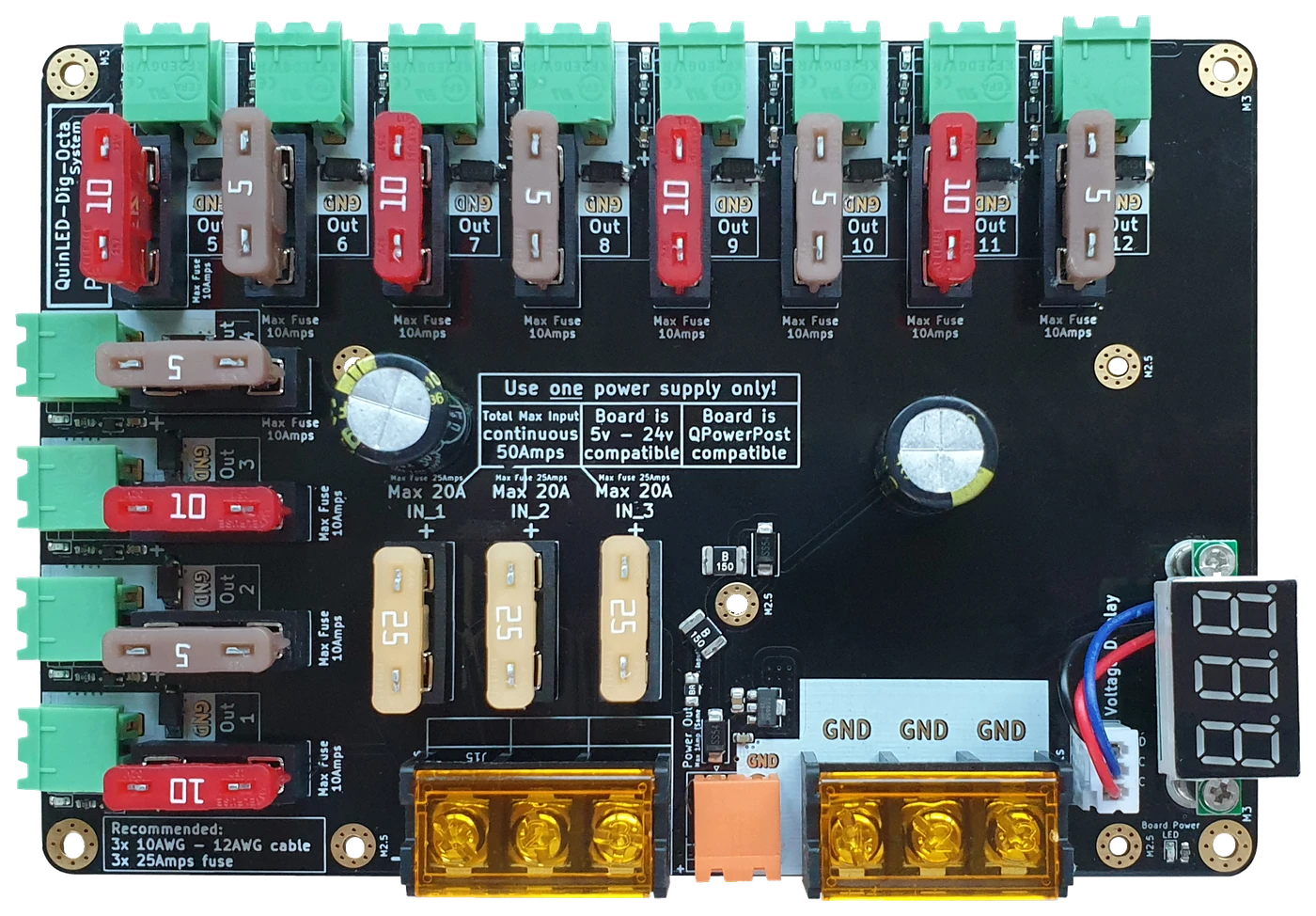
Three fused barrier inputs (20A each, wire all three) carry 50A continuous: 250W at 5V, 600W at 12V, 1,200W at 24V. Rated thermally for roughly 25 °C above ambient at full load.
Double up for home runs
Need more than 10A on one cable? One SV5.5-5 fork crimp bridges two adjacent terminals and parallels their two fuses: up to 20A on 10 AWG cable. Built for long home runs and bus-bar style distribution.
Reads its own voltage
The onboard display shows live voltage including drop under load, so a sagging supply shows up as a number, not a mystery flicker. Priceless in mixed-voltage stacks.
Happiest on top
Screw terminals sit higher than the fuses, so beneath another powerboard the fuses can't come out. Run the Power-7 as the top powerboard, or pre-wire it with xConnect pigtails. A brainboard above obstructs nothing.
Feeds the brains too
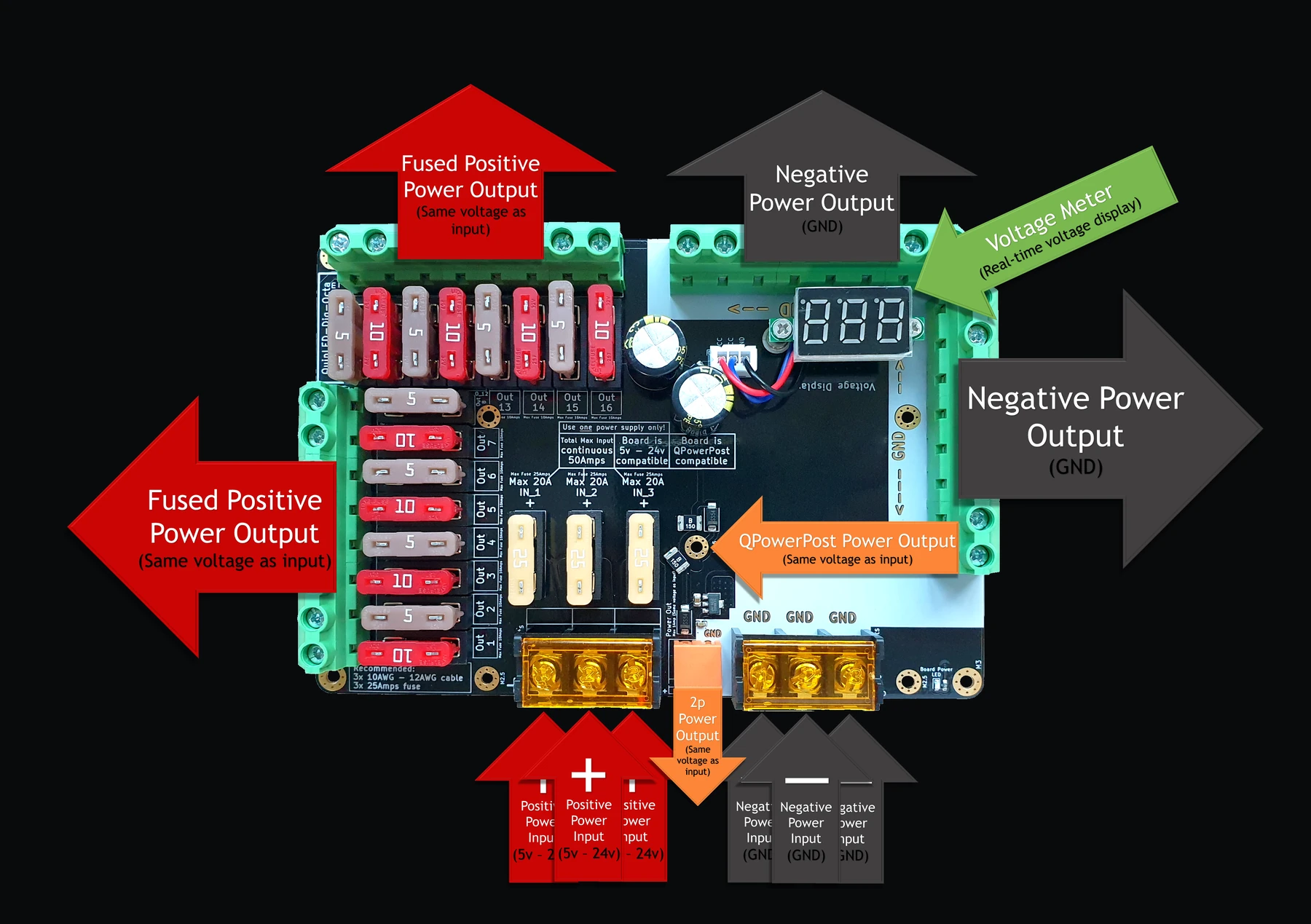
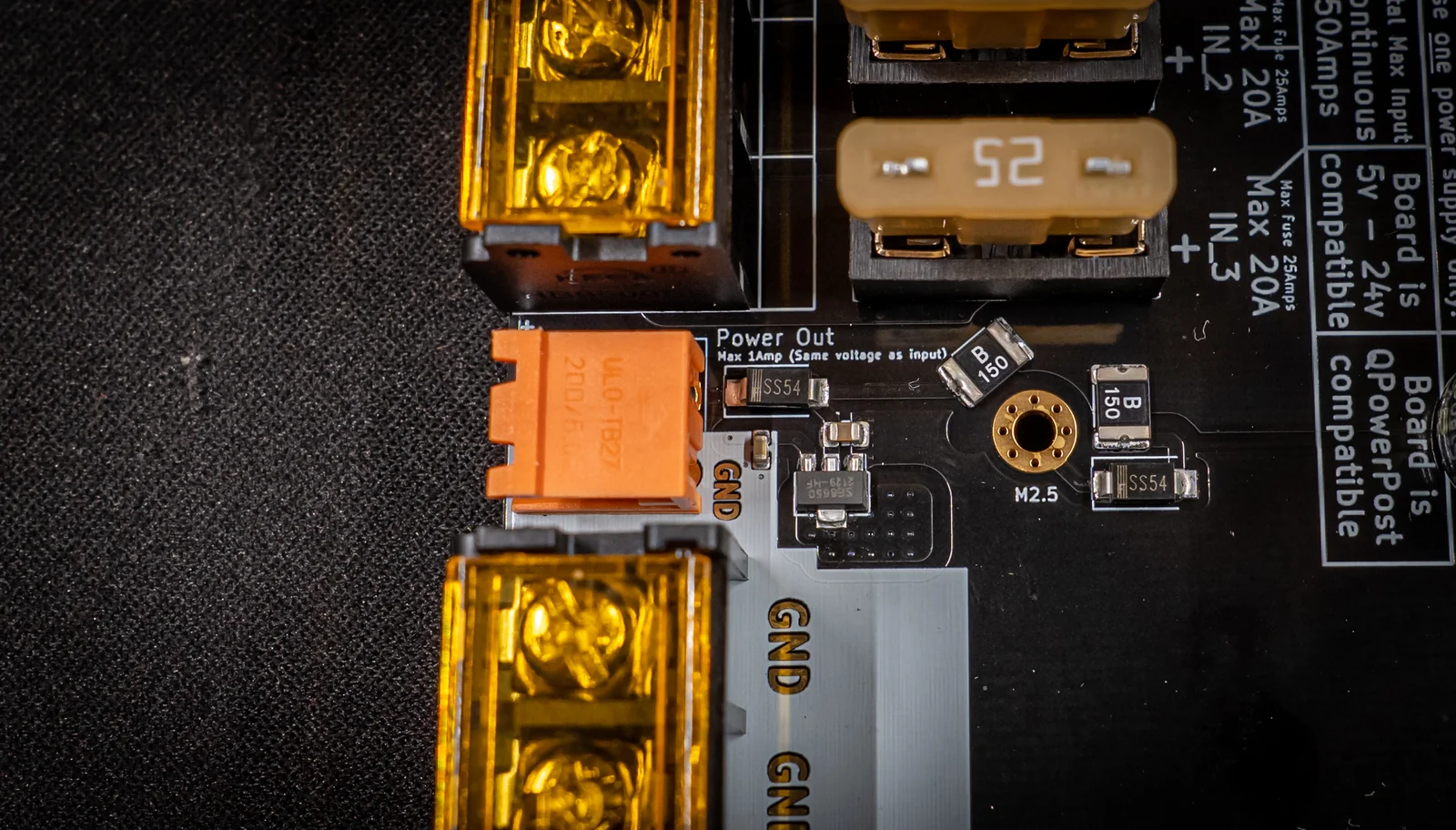
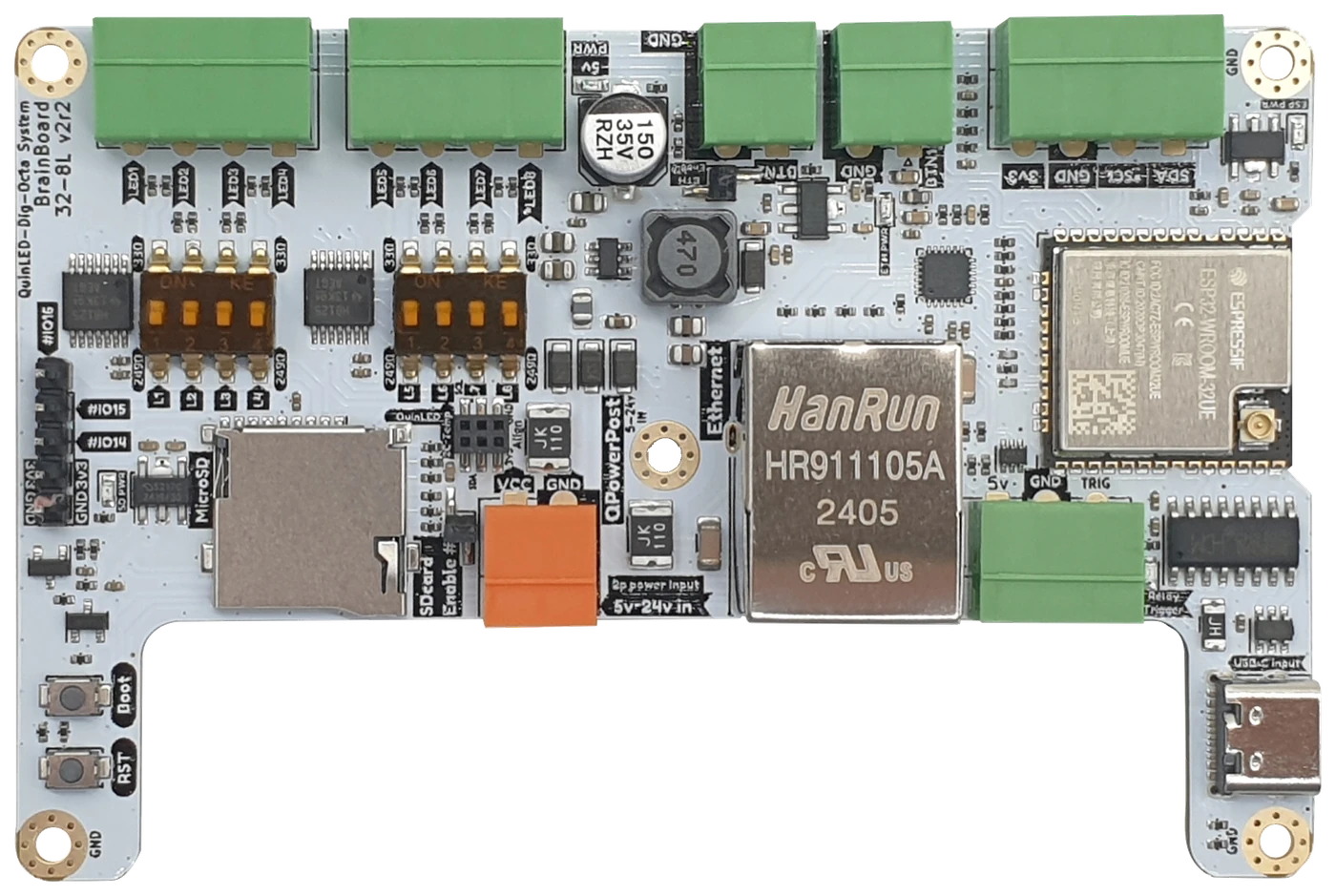
QPowerPost sends protected power up the standoffs to every brainboard above (1.5A PTC-fused), plus a spare pluggable brainboard-feed terminal if you skip the posts.
Every terminal, labeled.
Quindor's annotated power-flow map of the Power-7. Three fused inputs, sixteen screw-terminal outputs in four banks, QPowerPost in the middle.
Wire all three inputs
Each input terminal carries up to 20A (25A max fuse). The 50A rating assumes all three are wired to your supply; fewer cables lowers the ceiling. Use at least 3× 12 AWG, or 10/8 AWG for 5V builds.
Front 4A, middle 8A
Sixteen outputs make clean feeds easy: about 4A through a front feed, about 8A through a mid-strip injection. Interleave heavy and light runs across the three output sides, and plan the feeds with the ultimate power injection guide.
One PSU per board
Sixteen terminals invite creative wiring; resist it. Never wire two power supplies into one powerboard. One PSU can feed several powerboards, each board gets exactly one source.
The numbers that matter.
| Continuous power | 50A recommended max: 250W @ 5V · 600W @ 12V · 1,200W @ 24V |
| Voltage | 5–24V (one voltage per board, one PSU per board) |
| Inputs | 3× 9.5 mm barrier blocks, fused (max 25A ATO each, 20A per input); fork crimps preferred, SV5.5-4 fits Mean Well terminals too |
| Input cable | At least 3× 12 AWG; 10 AWG or 8 AWG preferred for 5V builds |
| Outputs | 16× 7.62 mm screw terminals in 4 banks of 8 (2 positive, 2 negative, over 3 sides), fuse socket per output, max 10A ATO; cable up to 12 AWG with ferrule |
| Double-up | One SV5.5-5 fork crimp across 2 adjacent terminals parallels 2 fuses: up to 20A and 10 AWG cable, ideal for home runs |
| Fuse type | LittelFuse ATO (automotive blade) sockets, input and output; blown-fuse LED per output |
| Capacitors | 2× 1,500 µF 35V bulk + 1 µF 50V per output |
| Monitoring | Onboard 7-segment voltage display (reads true board voltage, drop included) |
| Brainboard power | QPowerPost via standoffs + spare 5.08 mm feed terminal, both PTC-protected at 1.5A |
| Stacking | Fuses sit lower than the terminals: unreachable beneath another powerboard. Run it on top or pre-wire; a brainboard above obstructs nothing |
| Thermals | ~25 °C rise above ambient at 50A continuous |
| Mounting | 4× M3 holes (GND); 5× M2.5 QPowerPost positions; board height 30 mm; components on the back, so always use the included standoffs |
| Advised PSUs | Mean Well LRS-350-5 (60A @ 5V) or LRS-600-12 (50A @ 12V); run PSUs at ≤80% |
| In the box | 3× 25A + 8× 10A + 8× 5A fuses, brainboard feed connector, full standoff and screw kit |
Revisions, documented.
| Version | Released | What changed |
|---|---|---|
| v1r2 | 2024-10 | Small revision: extra protections around the onboard LDO. Layout, terminals and ratings unchanged. |
| v1r1 | 2022-11 | Original release. |
Full changelog on quinled.info. Need more than 50A from this layout? That's the Power-7HC: same outputs, 100A input stage.
Give it a brain. Or compare.
Density without the mess.
One checkout hub: every order starts at quinled.shop, which hands you to the reseller for your region.
Warranty is 6 to 12 months on every board. If something acts up, come to the Discord: we troubleshoot it together, and faulty hardware gets replaced. Hardware by Quindor.
A 19-fuse assortment (3× 25A, 8× 10A, 8× 5A), the brainboard feed connector and the full stacking kit ship in the box. Bring wire, one power supply, and a Brainboard-32-8L on top to run the show.