
High voltage, straight answers.
High voltage raises good questions. The answers come from the official Power-5HV documentation. Search, or jump by category.
No matches. Try another word, or ask on Discord.
Voltage & LEDs
What LEDs actually need 24-48V?
The newer generations of addressable lights. In 2024 more options appeared than ever, including 36V Govee-style strips and 48V puck and string RGBW lights. The Power-5HV exists to run exactly these natively in a Dig-Octa stack, and it stays compatible with all other Dig-Octa hardware. At 48V its 30A continuous rating means 1,440W from one board, and the 12 outputs use SMD 1808 fuses because ordinary ATO blade fuses are only rated to 32V. The brainboard needs no changes: QPowerPost hands it a down-converted ~15V automatically, so the same controller that runs 5V strips drives 48V pixels.
Can it run my 5V or 12V strips too?
Why does the silkscreen on my board say 5v-24v?
It's a known cosmetic bug, nothing more. v1r2 boards carry a silkscreen error right in the middle: the text reads '5v-24v' where it should say '24v-48v'. Electrically the board is and remains a 24-48V design; the bug is documented on the official product page.
Fuses
Why does it use different fuses than the other powerboards?
Voltage. Generally available ATO blade fuses only carry ratings up to 32V, which disqualifies them at 48V. The SMD 1808 fuse style is rated far beyond 48V, and testing showed the fuse brand matters little while socket quality matters a lot. The full engineering story is in 'The need for a new fuse' on quinled.info.
Where do I buy replacement 1808 fuses?
The tested fuses and shops are listed on the 'Fuses used for QuinLED 48v products' page; typical pricing is a few dollars for a 10 to 50 piece pack. One rule applies everywhere: a lower value is always fine and actually encouraged, while installing a larger value than the printed maximum voids your warranty.
Why are only 5A fuses included?
Because small fuses move serious power at these voltages: 10A at 48V is 480W down a single run. The included 12x 5A fuses cover realistic runs while nudging you to fuse to the wire. The sockets do accept up to 10A where one run genuinely needs it. The included fuses are high quality original LittelFuse parts.
Can I change the input fuses?
No, and you never need to. The three inputs carry fixed auto-reset PTC fusing at 10A per input, not changeable and with nothing to stock. After a fault clears, a PTC fuse resets itself and power flow resumes.
Are the output fuses reachable in a stack?
Partly. The pluggable output ports stay reachable with boards stacked above, but the flat 1808 fuse sockets are not as accessible as the Power-5's upright ATO sockets. If you expect to service fuses, keep the 5HV as the top powerboard or plan access into the enclosure.
Power & inputs
Why does the board have three input terminals?
To spread the load over more copper and to match how PSUs are built: Mean Well's LRS-350 and LRS-600, including their 36V and 48V versions, expose three output terminal pairs for three runs of 10 AWG (5.26mm²) wire, the thickest the fork crimps take. That keeps voltage drop between PSU and powerboard as small as possible. Each input carries fixed 10A PTC fusing, and all three together deliver the full 30A safely.
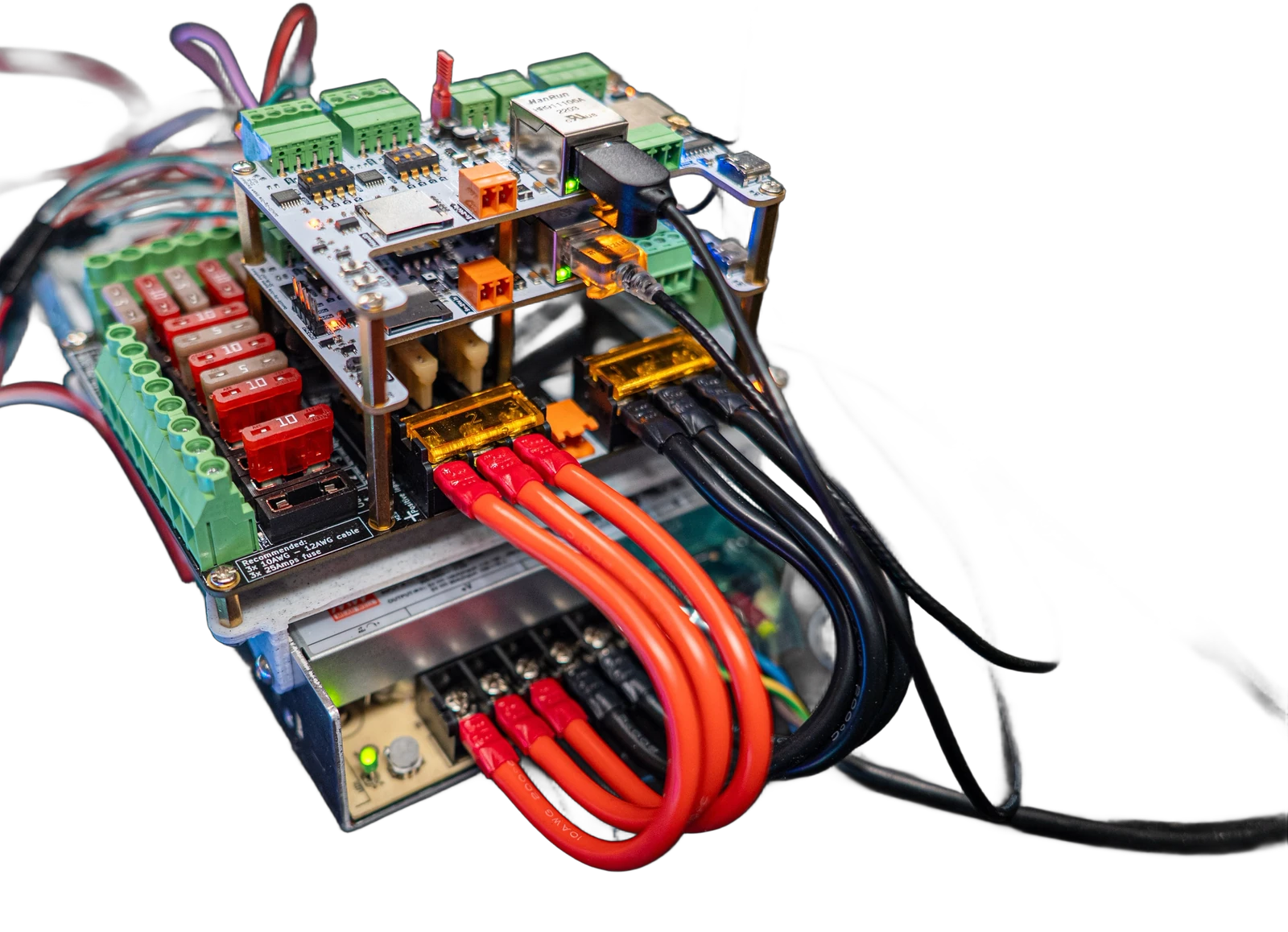
Why is it rated 30A when the Power-5 does 50A?
The fixed PTC input fusing caps each of the three inputs at 10A, so 30A total. Voltage makes up for current: 30A delivers 720W at 24V and 1,440W at 48V, which is more power than a Power-5 moves at 24V (1,200W).
Can I hot-plug LED connectors under power?
Don't. Hot-plugging was never supported, and 48V raises the stakes considerably: during testing of about 50 hot-plugs, 2 of them (roughly 1 in 25) damaged the output level shifter on the connected brainboard. Power down, plug in, power back up.
How does the brainboard get power from a 48V board?
Stepped down, automatically. An onboard DC-DC converter turns the 24-48V input into about 15V for the QPowerPost standoffs, and the spare brainboard feed terminal supplies the same 15V at up to 1A. The brainboard accepts that directly and never sees 48V.
Buying
Where can I buy the Power-5HV and what does it cost?
At quinled.shop, which routes you to the trusted reseller for your region: Allnet ships worldwide (US$37.49 at the time of writing), DrZZs covers the US, Jerems covers Canada and QuinLED NL serves the EU. The 12 output fuses, connectors and stacking hardware ship in the box.