
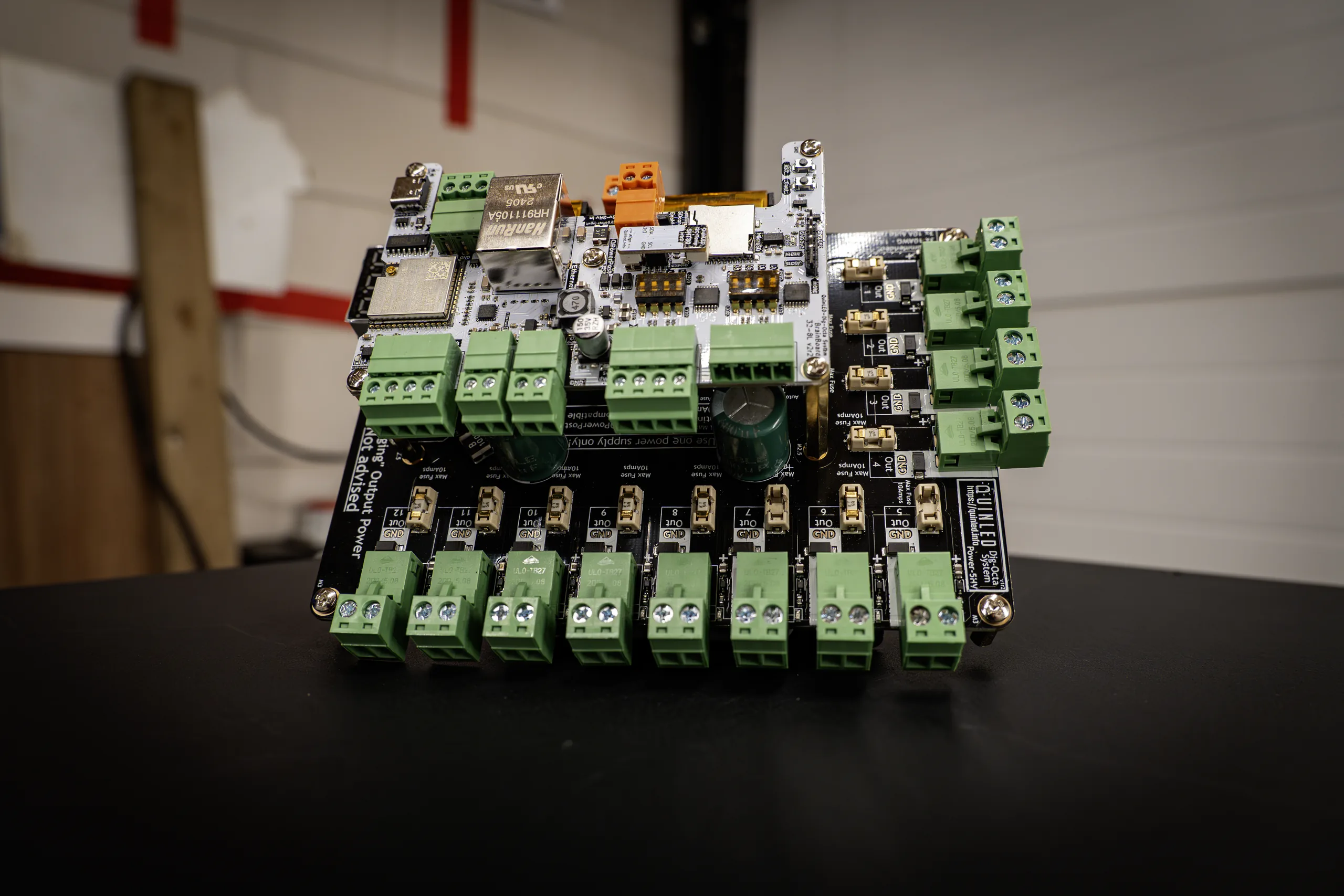
High voltage,
handled.
36V and 48V LEDs, run natively. The Power-5HV feeds 30A continuous at 24–48V through 12 individually fused pluggable outputs: up to 1,440W from one board, stack-compatible with every other Dig-Octa.
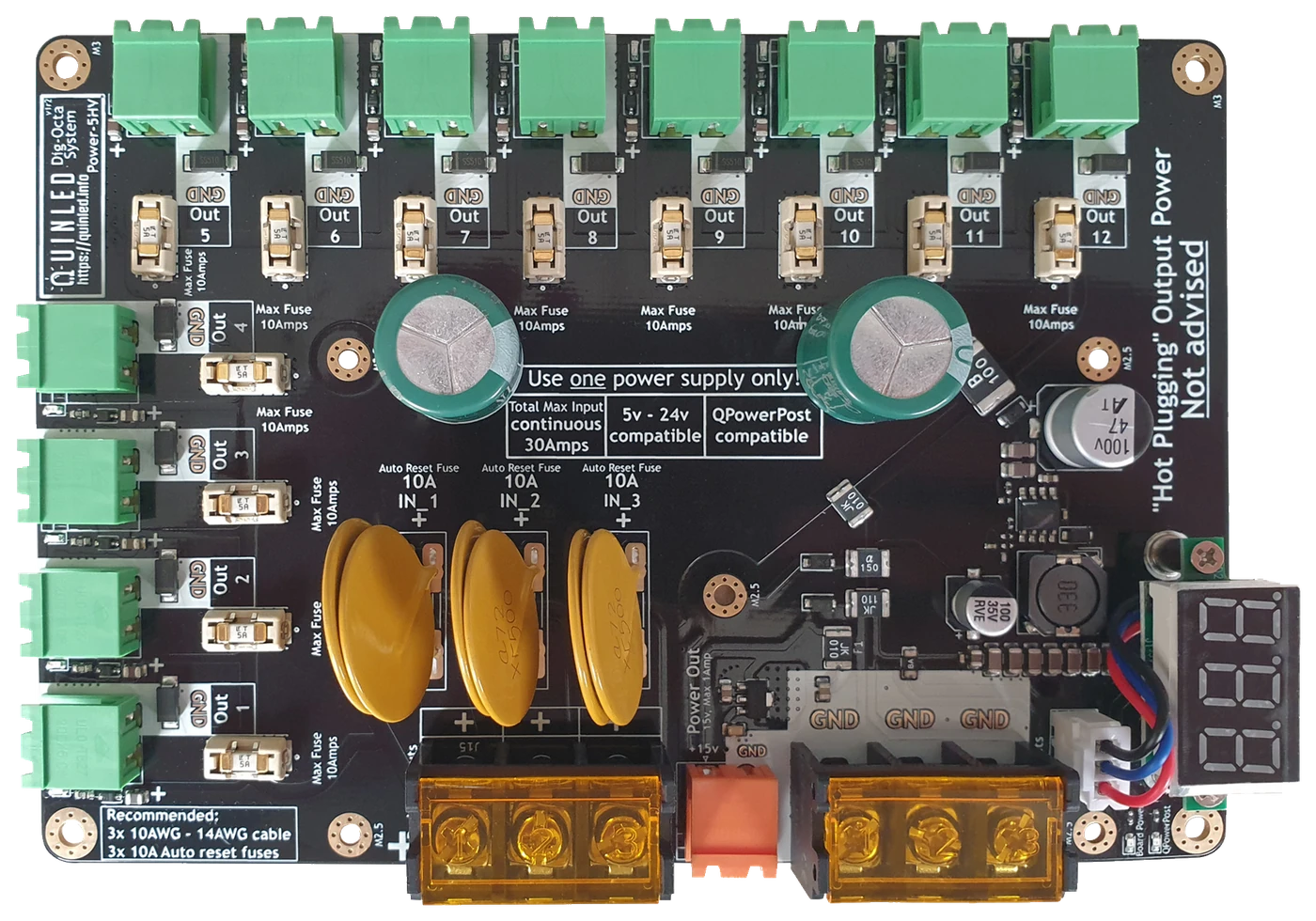
Released 2024-11 as v1r2. One known cosmetic quirk: the center silkscreen reads "5v-24v" where it should say "24v-48v". Print error only, the board itself is pure 24–48V. Details in the version history.
36 and 48 volts, native.
Addressable LEDs outgrew 24V: in 2024, Govee-style strips run 36V and puck or string RGBW lights run 48V. The Power-5HV runs them natively and makes Dig-Octa a true 5–48V system. Wire each run to one of 12 fused, pluggable ports, click it in, and read true board voltage off the red display.
48 volts changed the details.
The layout is pure Power-5, but the voltage forced new engineering: a different output fuse, fixed auto-reset input fusing and a down-converting stack bus. Here's what matters.
Twelve outputs, one new fuse
Each output pairs + and − on one pluggable 5.08 mm connector with its own SMD 1808 fuse socket and blown-fuse LED. ATO blade fuses stop at 32V; the 1808 doesn't. Max 10A per output, but 10A at 48V is 480W. Fuse to what the wire needs; 12× 5A ship in the box.
1,440 watts, one board
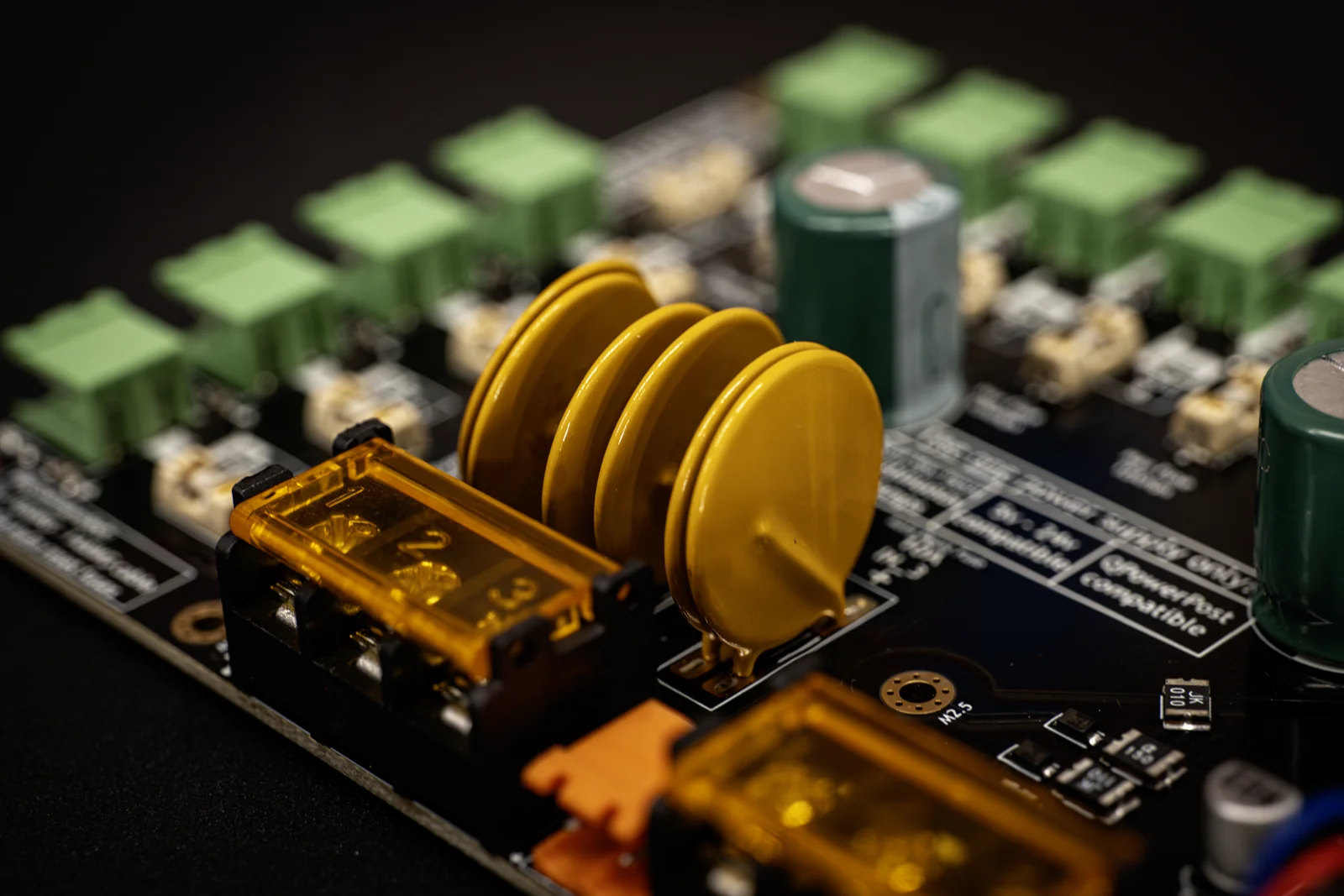
Three PTC-fused inputs carry 30A continuous: 720W at 24V, 1,440W at 48V. Rated thermally for roughly 25 °C above ambient at full continuous load, the same real-world standard as every Dig-Octa powerboard.
Inputs that reset themselves
Input fusing is fixed: six 5A auto-reset PTCs arranged as 3× 10A. Nothing to buy, nothing to swap; a tripped PTC recovers once the fault clears. Max 10A per input, so the full 30A needs all three terminals wired.
Never plug in hot
Hot-plugging was never supported, and 48V raises the stakes. In testing, roughly 1 in 25 hot-plugs damaged the output level shifter on the brainboard. Kill power, plug in your LED connectors, then power back up. Every time.
Faults announce themselves
A blown fuse lights its own indicator beside the output, and the red 7-segment display shows live board voltage, PSU-to-board drop included. A sagging supply shows up as a number, not a mystery flicker.
Stacks fine, with one twist
QPowerPost down-converts the 24–48V input to roughly 15V for the stack bus (1.5A PTC), so brainboards just work. The twist versus the Power-5: output ports stay reachable mid-stack, the 1808 fuse sockets don't. Fit fuses first, or keep it on top.
Every terminal, labeled.
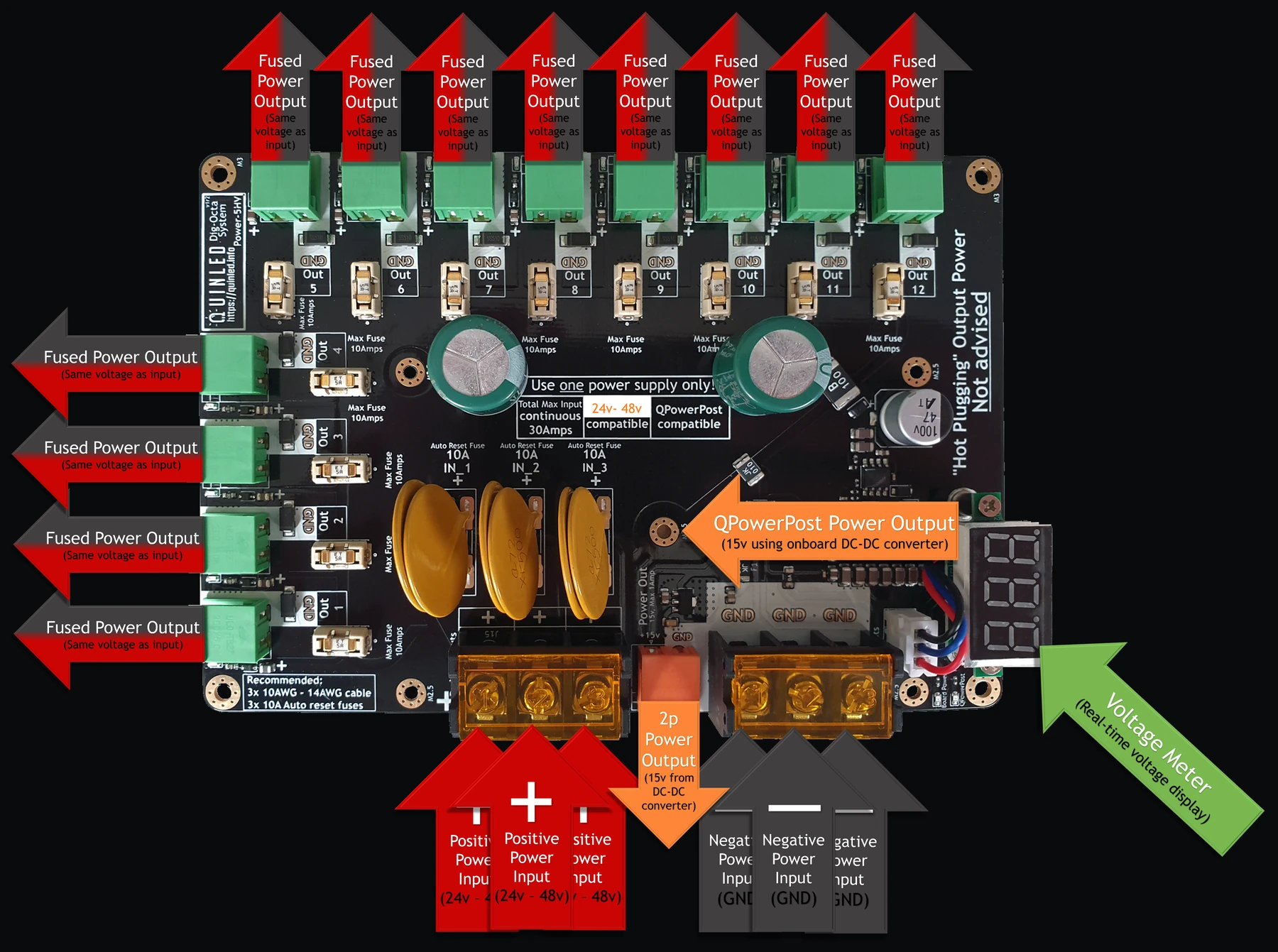
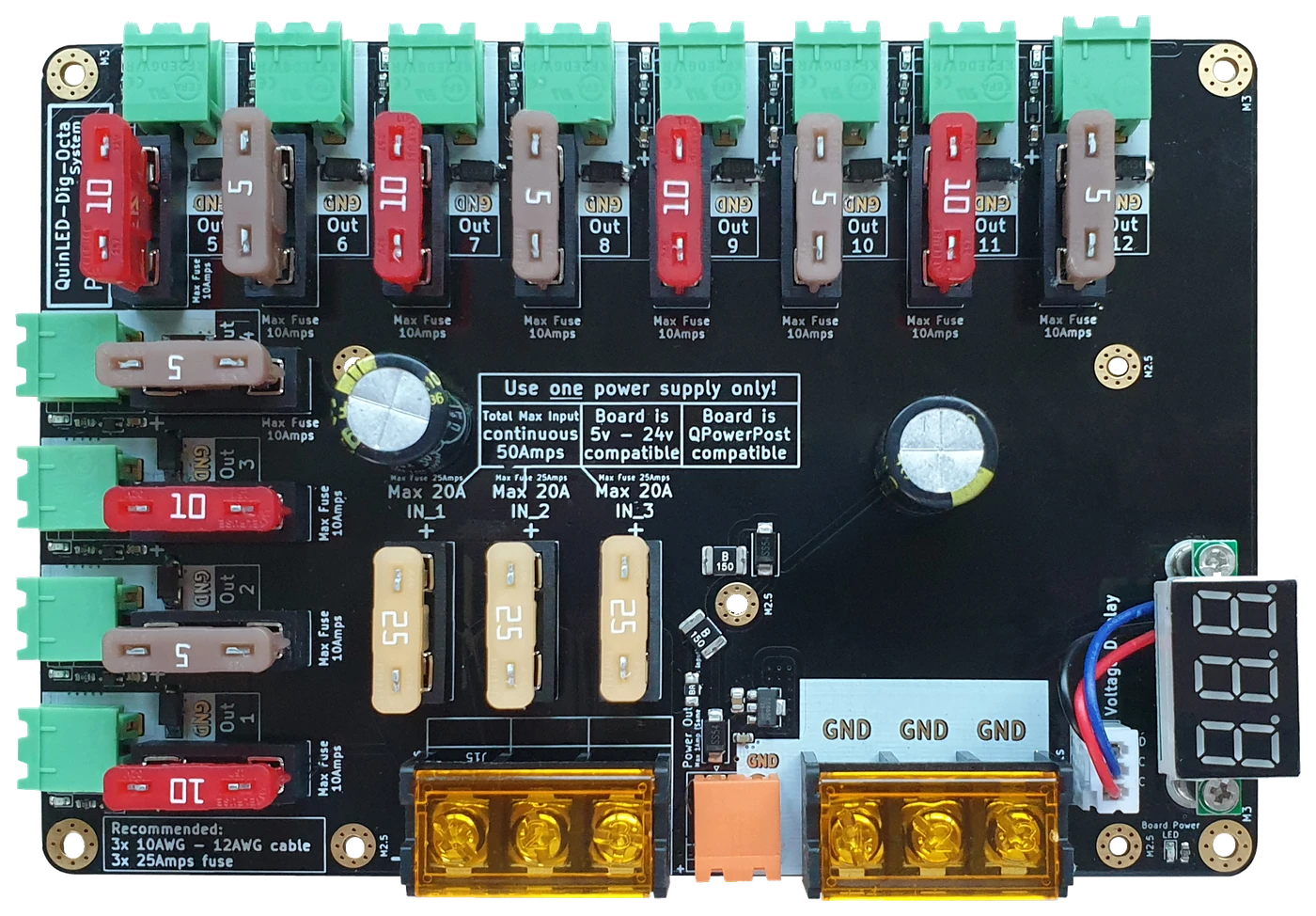
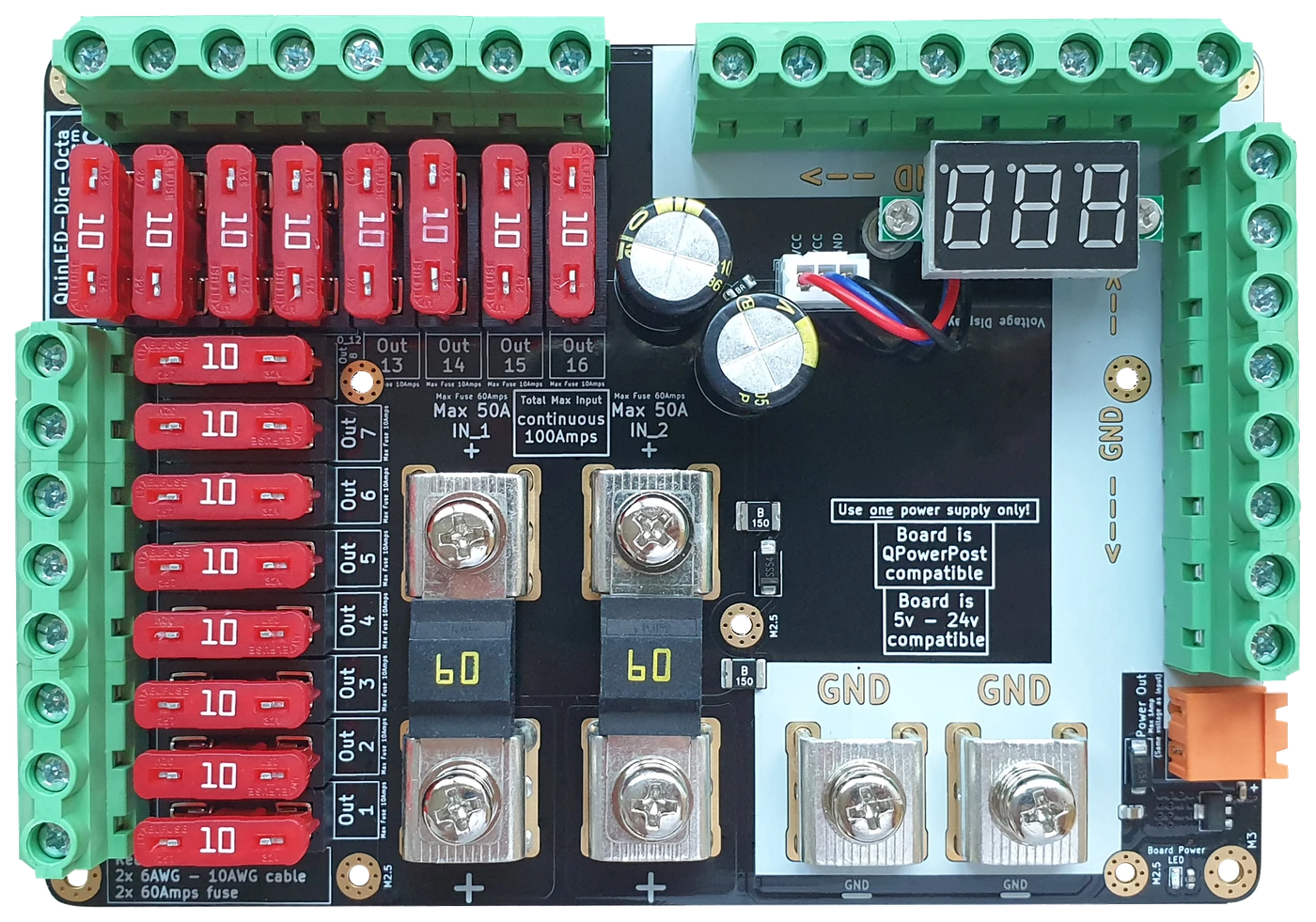
Quindor's annotated power-flow map of the Power-5HV. Three PTC-fused inputs, twelve fused outputs around the edges, QPowerPost in the middle.
Wire all three inputs
Each input carries up to 10A through its fixed PTC fusing. The 30A rating assumes all three are wired to your supply; fewer cables lowers the ceiling. Use at least 3× 16 AWG; 12 AWG is the sweet spot.
Front 4A, middle 8A
The feed rules hold at high voltage: about 4A through a front feed, about 8A through a mid-strip injection. At 48V every amp moves four times the watts of 12V, so those feeds go far. Plan them with the ultimate power injection guide.
One PSU per board
Never wire two power supplies into one powerboard; at 24–48V a load-sharing fault is especially unforgiving. One PSU can feed several powerboards, but each board gets exactly one source.
The numbers that matter.
| Continuous power | 30A recommended max: 720W @ 24V · 1,440W @ 48V |
| Voltage | 24–48V (one voltage per board, one PSU per board) |
| Inputs | 3× 9.5 mm barrier terminals with fixed PTC auto-reset fusing: 6× 5A PTCs arranged as 3× 10A, not user-changeable; max 10A per input; fork crimps up to 10 AWG |
| Input cable | At least 3× 16 AWG; 12 AWG is the sweet spot |
| Outputs | 12× 5.08 mm pluggable terminals (+ and − together), SMD 1808 fuse socket per output, max 10A; cable up to 14 AWG with ferrule |
| Fuse type | SMD 1808 on outputs (ATO blade fuses only go to 32V); fixed PTC auto-reset on inputs; blown-fuse LED per output; ships with 12× 5A |
| Capacitors | 2× large 80V bulk capacitors + 1 µF 100V per output |
| Monitoring | Onboard 7-segment voltage display (reads true board voltage, drop included) |
| Brainboard power | QPowerPost via standoffs, input down-converted to ~15V (1.5A PTC); spare feed terminal supplies 15V at max 1A (PTC-protected) |
| Stacking | Output ports stay reachable mid-stack; the 1808 fuse sockets do not. Fit fuses before stacking, or keep it on top |
| Thermals | ~25 °C rise above ambient at 30A continuous |
| Mounting | 4× M3 holes (GND); 5× M2.5 QPowerPost positions; board height 30 mm; same footprint as every Dig-Octa powerboard |
| Advised PSUs | Mean Well LRS-600-48 (12.5A @ 48V) or bigger; lower-current supplies are fine too; run PSUs at ≤80% |
| In the box | 12× 5A SMD 1808 fuses, 13 pluggable connectors, full standoff and screw kit |
Revisions, documented.
| Version | Released | What changed |
|---|---|---|
| v1r2 | 2024-11 | First public release. Known cosmetic bug: the center silkscreen reads "5v-24v" where it should read "24v-48v". Print error only; electrically the board is a 24–48V design. |
Full changelog on quinled.info. The Power-5HV is the only Dig-Octa powerboard for 24–48V; for 5–24V with the same pluggable layout, that's the Power-5.
Give it a brain. Or compare.
Forty-eight volts. Zero drama.
One checkout hub: every order starts at quinled.shop, which hands you to the reseller for your region.
Warranty is 6 to 12 months on every board. If something acts up, come to the Discord: we troubleshoot it together, and faulty hardware gets replaced. Hardware by Quindor.
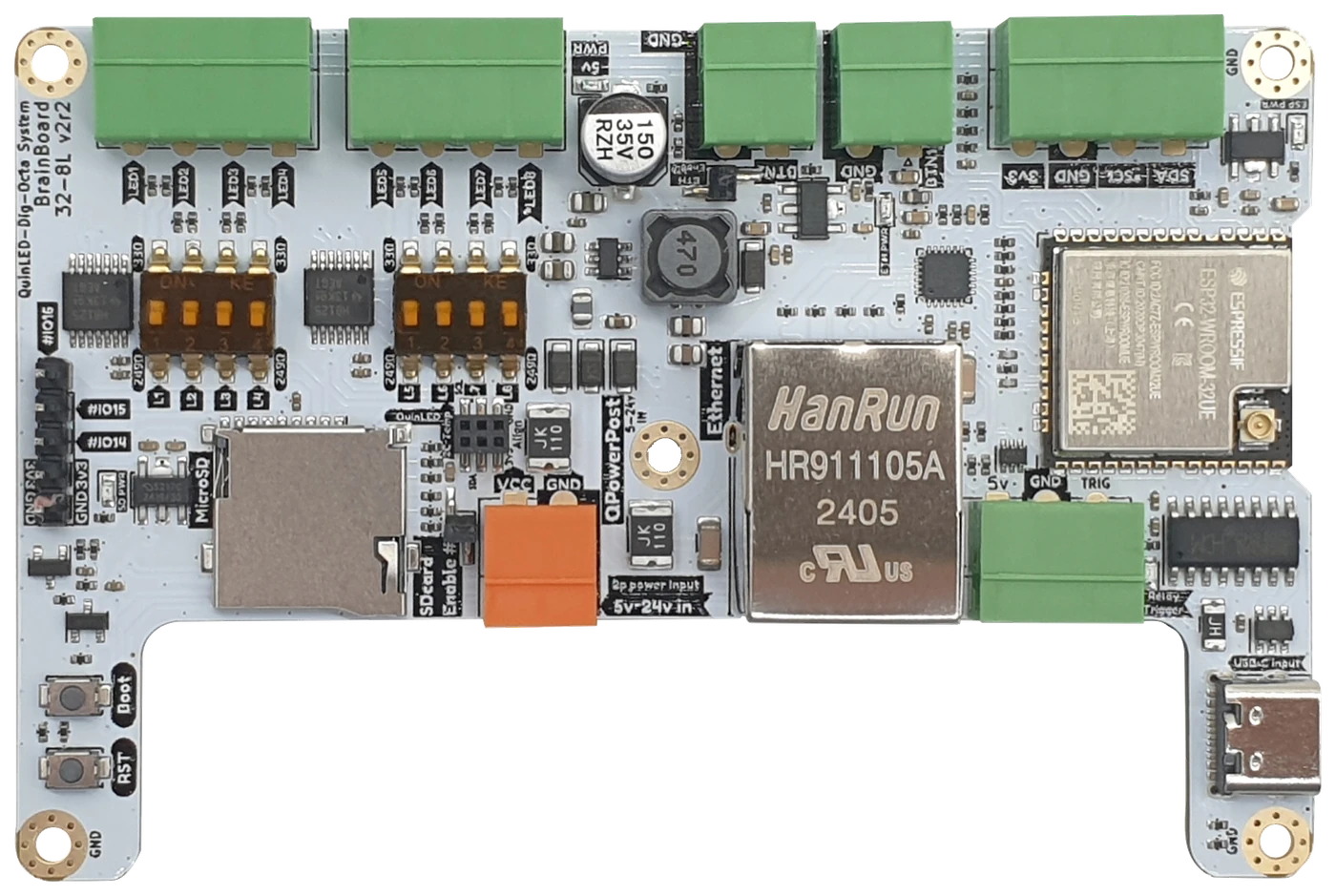
Twelve 5A fuses, thirteen pluggable connectors and the full stacking kit ship in the box. Bring wire, one 24–48V power supply, and a Brainboard-32-8L on top to run the show.